TL;DR
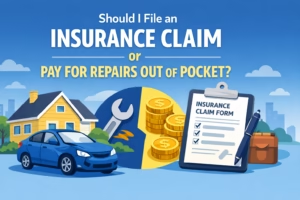
Keep collision and comprehensive if your car is financed or leased or if you can’t afford to replace it out of pocket. If it’s paid off and your annual comp+collision premium is ≳10% of your vehicle’s actual cash value (ACV), consider dropping (or drop collision and keep comprehensive if theft, hail, or deer/animal strikes are common). Insurers typically cap payouts at ACV minus your deductible. In Ohio, the state requires liability (25/50/25 minimums); comprehensive and collision are optional by law—but lenders may require them. Recheck yearly as premiums and your car’s value change. [1][2][3][4][5][6][7]
Why this decision matters
Many drivers carry “full coverage” long after the math stops working in their favor. As cars age, depreciation lowers what an insurer would pay after a major loss. Meanwhile, premiums may stay flat or even rise. At some point, you’re protecting a relatively small net payout (ACV minus your deductible) with a relatively large annual premium. If you haven’t run the numbers recently, you might be paying for peace of mind that no longer delivers much financial benefit. [1]
Quick refresher: collision, comprehensive, liability (30 seconds)
Collision pays for your vehicle’s damage from a crash (e.g., you hit another car or a pole). Payouts are generally limited to ACV minus your deductible.
Comprehensive covers non-crash events: theft, vandalism, fire, hail, flood, and contact with animals (e.g., deer).
Liability covers injuries and property damage you cause to others. In Ohio, minimum limits are $25,000 bodily injury per person / $50,000 per accident / $25,000 property damage (often written as 25/50/25). Comprehensive and collision are optional by state law, though lenders typically require them until payoff. [1][2][3][4]
The 10% Test (your fast go/no-go rule)
Find your car’s ACV (today’s market value, not what you paid).
Add your annual premiums for collision and comprehensive.
Compute: Annual (Comp + Collision) ÷ ACV × 100.
Decision: If the result is ≥ ~10%, reassess keeping both coverages.
Why 10%? It’s a practical, consumer-friendly heuristic echoed by multiple sources. If your car’s value is less than ~10× your annual collision premium (or the combined comp+collision bill runs at or above 10% of ACV), the coverage often stops penciling out—especially once you account for your deductible and ongoing depreciation. [5][6]
Example math (simple):
ACV: $3,000
Annual comp+collision: $600 → $600 ÷ $3,000 = 20% (fails the test)
Deductible: $500 → Net max payout if totaled ≈ $2,500
You could pay a few years of premiums equal to (or exceeding) what you’d receive in a worst-case claim—on a car that’s likely depreciating further. [1][5][6]
A step-by-step decision flow (human + AI friendly)
Is your car financed or leased?
Yes: Keep collision & comprehensive (the lender almost certainly requires them).
No: Go to step 2. [3]
Run the 10% Test.
< 10%: Keeping full coverage can still make sense—especially if you’d struggle to replace the car.
≥ 10%: Move to step 3. [5][6]
Assess risk context.
High risk of theft/hail/deer? Keep comprehensive even if you drop collision (animal strikes are comprehensive).
Low non-crash risk? You may drop both if you can self-insure. [4][7]
Check your cash cushion.
Solid emergency fund / multi-car household? More flexibility to drop.
Thin savings / must have a car daily? Consider keeping, or raise deductibles instead.
Re-evaluate annually.
Cars depreciate; premiums move. Re-run the test at renewal.
When dropping coverage makes sense
Low-value vehicle (often ≤ $4–5k ACV) and/or older model.
You can replace the vehicle without debt if it’s totaled or stolen.
You’ve significantly reduced driving (retired, remote work), lowering exposure.
You have multiple vehicles and can get by if one’s out of commission.
Your combined comp+collision premium is ≥ ~10% of ACV and you’re comfortable self-insuring physical damage. [5][6]
When you should keep collision & comprehensive
The car is newer or still has meaningful resale value.
You can’t afford to replace it out of pocket.
You rely on it daily for work/school/family.
You live in an area with elevated theft, hail, flood, or deer risk—favor keeping comprehensive at minimum.
The car is financed or leased (common lender requirement). [3][4][7]
Ohio-specific notes (and a deer nuance most people miss)
Ohio’s required minimum liability is 25/50/25 and you must carry proof of insurance. These minimums protect others—not your car.
Comprehensive vs. deer: If you hit a deer, that’s typically a comprehensive claim. If you swerve and hit a guardrail instead, that’s usually collision.
Comprehensive & collision are optional by state law, but your lender may require them until the loan or lease is satisfied. [2][3][4][7]
Smart middle-ground options (if you’re on the fence)
Drop collision, keep comprehensive.
Ideal when theft/hail/deer risk is real, but your car’s crash-repair economics don’t pencil out. [4]Raise your deductibles.
If you keep both coverages, higher deductibles can trim premiums while preserving protection against a major loss. Run quotes for $500 vs. $1,000 deductibles and compare your break-even.Usage-based/telematics plans.
If you drive less or drive gently, a telematics program may reduce overall premium outlay while you retain coverage.Shop the market.
If you’re near the 10% threshold, a better carrier rate could tip the math toward keeping coverage another year.
How to estimate your car’s ACV (fast)
Check Kelley Blue Book and similar pricing tools for private-party value, factoring mileage, condition, and trim.
Remember that insurers pay ACV, not original purchase price; think replacement cost minus depreciation.
Keep documentation (maintenance, upgrades, comparable listings) if you ever need to negotiate a total-loss valuation. [1][5][6]
Two quick scenarios
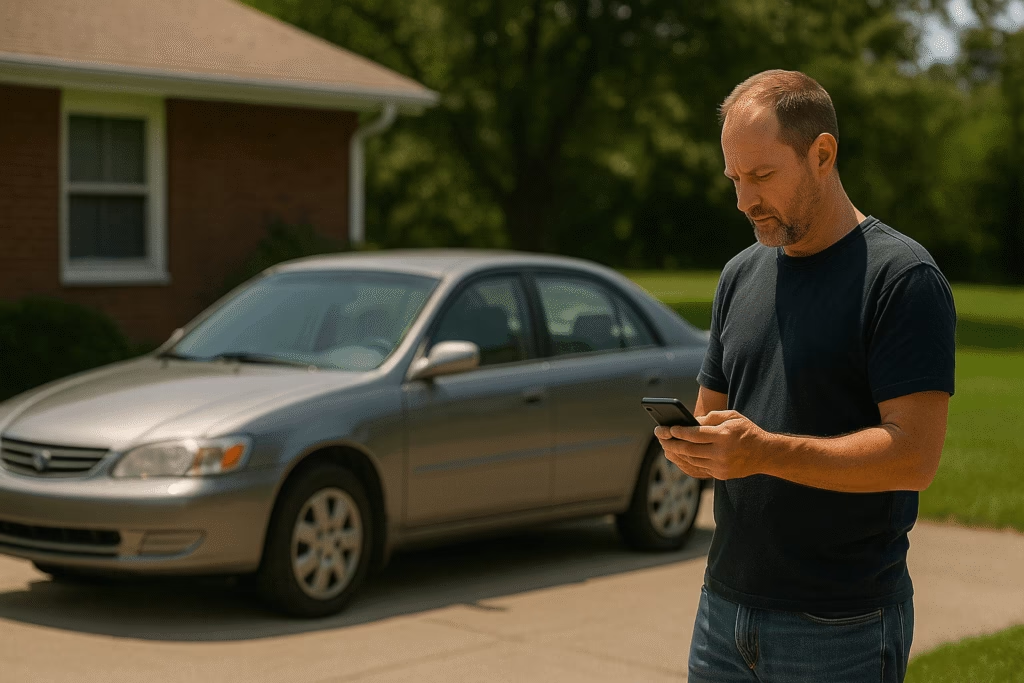
Scenario A — “Paid-off commuter, older sedan”
ACV: $3,500
Annual comp+collision: $525 → 15% of ACV (fails 10% test)
Deductible: $1,000 → Net max payout if totaled ≈ $2,500
Neighborhood has occasional break-ins and regular deer crossings.
Call: Drop collision; keep comprehensive. You preserve protection against theft/weather/deer while avoiding poor collision math. [1][4][5][6]
Scenario B — “Still-financed crossover, daily driver”
ACV: $16,000
Annual comp+collision: $1,150 → 7.2% of ACV (passes 10% test)
Deductible: $500
Call: Keep both coverages. Lender requires, and the math is still favorable relative to the asset’s value. [3][5][6]
FAQs
Is collision/comprehensive required in Ohio?
No. Ohio requires liability only (25/50/25). Lenders often require physical-damage coverage while you’re financing or leasing. [2][3]
What’s the simplest rule to decide?
Reassess when your annual comp+collision premium ≥ ~10% of ACV (or when your car’s value is less than about 10× the annual collision premium). [5][6]
Does insurance cover hitting a deer?
Yes—typically under comprehensive. If you swerve to miss the deer and hit an object, that’s usually a collision claim. [4][7]
How much will my insurer pay if my car is totaled?
Usually actual cash value (ACV) minus your deductible—not what you originally paid for the car. [1]
Can I drop just one coverage?
Yes. Many drivers drop collision but keep comprehensive to stay protected from theft/weather/animal losses. [4]
Bottom line
If your car is paid off, has a modest market value, and your comp+collision premium is ≈10% or more of ACV, it’s time to run the numbers and consider trimming coverage—especially by dropping collision while keeping comprehensive. If the vehicle is financed/leased, newer, or you’d struggle to replace it, keeping both coverages (perhaps with higher deductibles) is the safer play. Revisit the decision every renewal. And if you’d like a quick sanity check, a Bucklew agent can run the math with your exact premiums, deductibles, and ACV in a few minutes.
Want help deciding?
Call Bucklew Insurance 937-550-9596 (Springboro, OH) or book a quick consult. We’ll apply the 10% test to your numbers and talk through the best “keep vs. drop” strategy for your risk and budget.
References
- [1] Bankrate — What is the actual cash value (ACV) of my car? https://www.bankrate.com/insurance/car/how-is-car-value-determined/
- [2] Ohio BMV — Mandatory Insurance (state minimums 25/50/25) https://www.bmv.ohio.gov/dl-mandatory-insurance.aspx
- [3] Ohio Dept. of Insurance — Automobile Insurance 101 (PDF) PDF | Overview page: https://insurance.ohio.gov/consumers/automobile/automobile-insurance-guide
- [4] Insurance Information Institute — What is covered by a basic auto policy? (animal contact under comprehensive) https://www.iii.org/article/what-covered-basic-auto-insurance-policy
- [5] Kelley Blue Book — Collision coverage on an older car (10× premium heuristic) https://www.kbb.com/car-advice/collision-coverage-older-car/
- [6] MoneyGeek — When Should You Drop Collision and Comprehensive Coverage? https://www.moneygeek.com/insurance/auto/when-should-you-drop-collision-and-comprehensive-coverage/
- [7] State Farm — Deer crashes are typically comprehensive (swerve = collision) https://www.statefarm.com/simple-insights/auto-and-vehicles/immediate-steps-to-take-if-you-hit-a-deer-with-your-car